
If there is one monument that more than any other tells the story of Rome, it is Castel Sant'Angelo.
His imposing silhouette is reflected by almost Two thousand years in the waters of the Tiber, becoming a landmark for travelers, pilgrims and curious people of all ages.
Today we know him as national museum, but over the centuries it has been Imperial mausoleum, fortress, papal residence and prison. Each transformation has left a visible mark on its structure, creating a unique building where history, art and legend intertwine.
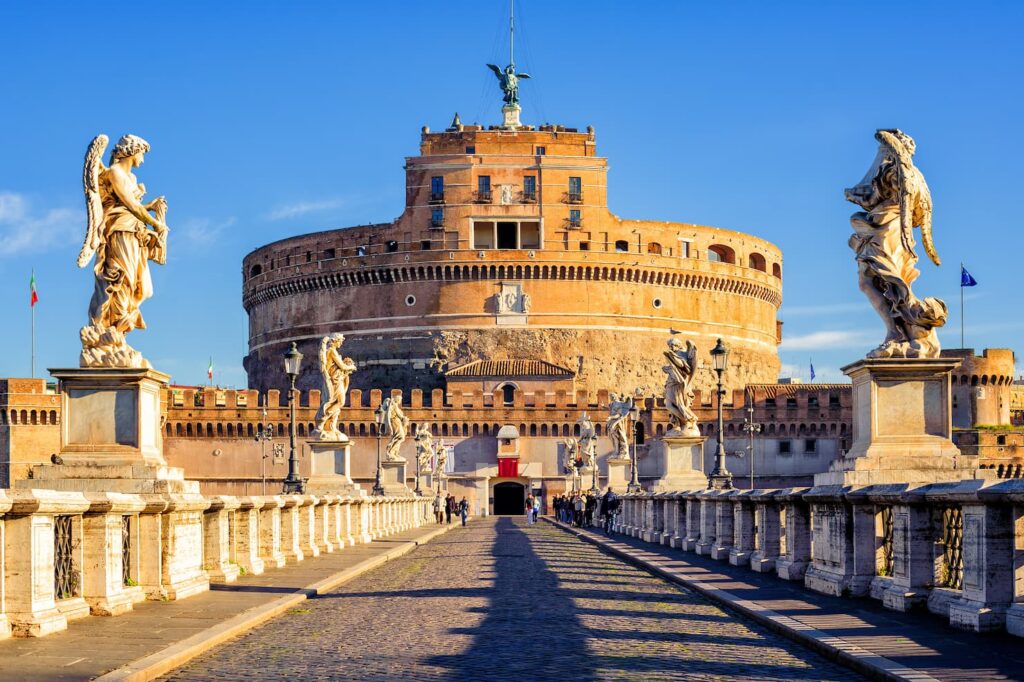
Located on the right bank of the Tiber, within walking distance of St. Peter's and the Vatican, the Castle is connected to the heart of the city by the striking Sant'Angelo Bridge, adorned with statues that welcome visitors on a path suspended between past and present.
To visit Castel Sant'Angelo is to accomplish a time travel, from the Imperial Rome at Renaissance, all the way to the modern age. It is a place that never ceases to amaze because it holds frescoed halls, art collections, ancient prisons and breathtaking views On the city.
If you are planning a trip to Rome, this is one of the must-see places on your itinerary. Buy your tickets for Castel Sant'Angelo and discover live one of the capital's most fascinating symbols.
The best-selling ever
Castel Sant'Angelo: Entrance ticket + audio guide
Quick access and audioguide included: explore Castel Sant'Angelo and Roman Forum with one ticket.
Secure payment
Immediate confirmation
Cell phone ticket
The History of Castel Sant'Angelo
Origins: the Mausoleum of Hadrian

When it was built, what we call today Castel Sant'Angelo was not a castle but a imperial mausoleum. It was wanted by theEmperor Hadrian around the 123 AD., for himself and his family, in a then suburban area of Rome called Ager Vaticanus.
The project was entrusted to thearchitect Demetriano and finished in the 139 AD. under the successor Antoninus Pius. The structure, inspired by the Mausoleum of Augustus, was great:
- one quadrangular base Covered in white marble;
- two overlapping cylinders That were narrowing upward;
- a roof garden With evergreen trees;
- bronze statues at the corners and a Bronze quadriga led by the emperor On the top.
The mausoleum was connected to the rest of the city by the Pons Aelius, the current Sant'Angelo Bridge, which formed its monumental entrance. Inside it housed the Urn Hall, intended to house the ashes of the imperial dynasty.
Here they were buried, in addition to Adriano and to his wife Vibia Sabina, also Antoninus Pius, Marcus Aurelius, Commodus, Septimius Severus, Julia Domna, Caracalla and other members of the imperial family.
For about 150 years the mausoleum fulfilled its original function. Then, with the barbarian invasions and the construction of the Aurelian Walls, permanently lost its funerary role to become the military fortress.
Do you want to find out how this transformation came about? Continue reading the next section and, if you are planning your visit, don't forget to book tickets for Castel Sant'Angelo to take a closer look at the still-visible remains of the Mausoleum of Hadrian.
From mausoleum to fortress
The history of Castel Sant'Angelo changes dramatically in the 403 AD.. L'Emperor Honorius decides in fact to include the Mole Adriana within the Aurelian Walls, transforming it from sepulcher a military fortress.
This choice marks the end of the funeral function and the beginning of the second life of the monument. The mausoleum becomes a castellum, an advanced defensive outpost on the Tiber, ready to protect the city from invasion and siege.
It is precisely during this period that the structure reveals its full importance. During the 410 AD sack of Rome. by the Visigoths of Alaric and then in the 455 AD. with the Vandals of Genseric, the castle was a strategic point for the defense of the capital.
As the centuries passed, Castel Sant'Angelo was consolidated as a impregnable fortress, adapted from time to time to new military needs. Finds such as the famous Faun Barberini, probably used as a defensive weapon during a siege.
His position, halfway between the Tiber and the Vatican, made it not only a military bastion, but also a symbol of power. It was from this stage that the building began to earn its reputation as an indestructible stronghold, destined to accompany Rome for centuries to come.
Castel Sant'Angelo in the Middle Ages
With the fall of the Roman Empire, Castel Sant'Angelo takes on a new role of disputed stronghold. From the 10th century it became the focus of struggles between the great Roman families: first the Teofilatti, then the Crescenzi, i Pierleoni and finally the Orsini.
Not surprisingly, at that time the castle was known as the Castrum Crescentii, precisely in honor of the family that fortified it for a long time. The walls, towers and ramparts were strengthened to resist wars and riots, making the complex even more fearsome.
The real turning point comes with Pope Nicholas III Orsini (1277). It was he who wanted the construction of the famous Passetto di Borgo, the fortified corridor that directly connects Castel Sant'Angelo with the St. Peter's Basilica. This secret passage, about 800 meters long, allowed the popes to have a safe haven in case of attack.
From 1367, with the delivery of the keys to Pope Urban V, Castel Sant'Angelo becomes permanently church property. Since that time its history has been inextricably linked with the pontiffs: shelter in times of danger, repository of the Vatican Treasure, court and even state prison.
Its reputation for impregnability, combined with its strategic location, made it one of the most important places of papal power. It is at this stage that Castel Sant'Angelo ceases to be just a fortress and begins to transform into fortified papal residence, a prelude to the sumptuous Renaissance modifications.
Renaissance and popes

Among Fifteenth and sixteenth centuries Castel Sant'Angelo knows a new season. From a simple fortress, it is transformed into a fortified papal residence, a safe place but also rich in pageantry and art.
The first to effect a radical change was pope Alexander VI Borgia (1492-1503). With the help of the architect Antonio da Sangallo the Elder, had the following built new ramparts, a entrance tower and a defensive moat. But not only that: the castle also became a palace, with apartments frescoed by Pinturicchio, gardens and fountains.
Successor, Julius II Della Rovere, preferred to live for almost a year in the castle rather than in the Vatican. He had the famous Loggia on the Tiber and commissioned interventions from masters such as Michelangelo, called to work on the chapel dedicated to the SS. Cosmas and Damian.
During the Renaissance, Castel Sant'Angelo never lost its defensive function. It proved this in the 1527, when pope Clement VII withstood for seven months the siege of the Lansquenets of Charles V, taking refuge in the castle and using the Passetto di Borgo As an escape route.
In the following decades, other pontiffs, such as Paul III Farnese e Paul IV Carafa, they enriched the castle with frescoed rooms, lodges and especially with the construction of the pentagonal bastion wall, which still surrounds the structure today.
The Renaissance thus marked the perfect balance between Military function and artistic splendor. A castle that was both a fortress, a palace and a symbol of power.
Want to see the frescoes and loggias of the Renaissance popes in person? Buy tickets for Castel Sant'Angelo here and immerse yourself in its unique atmosphere between art and history.
Castel Sant'Angelo from the modern age to the Risorgimento

From Six hundred onward, Castel Sant'Angelo continues to transform following the needs of the time. With Pope Paul IV the pentagonal bastion wall, while Urban VIII Barberini ordered the demolition of some earlier structures and the relocation of the main entrance. This is a time of major defense work, with new guard posts and curtain walls.
In Seventeenth and Eighteenth Centuries, the castle remains at the center of papal life as a fortress, prison and arsenal. Some pontiffs also use it to celebrate the power of the Church with additional embellishments.
With the arrival of theNineteenth century and the decline of the temporal power of the popes, Castel Sant'Angelo changed function again. During the Napoleonic period and then after theUnification of Italy, is used as political prison and later as barracks.
The big step comes in the 1906, when, thanks to the restorations directed by Marquis Louis Durand de la Penne and by the contributor Mariano Borgatti, the building becomes home to the Museum of Military Engineering. In the course of the Twenty-year fascist period (1933-1934) new interventions are made: the ditches and the ramparts, demolished the 19th-century barracks and laid out the garden area.
Since then, Castel Sant'Angelo has been permanently consecrated to culture, until it became the current National Museum of Castel Sant'Angelo, one of the most visited attractions in Rome.
Why it is called Castel Sant'Angelo: the legend of Archangel Michael
The name Castel Sant'Angelo arises from a 6th century legend combining history, faith and miracle. In 590 AD., during a terrible plague epidemic ravaging Rome, the new pontiff Gregory the Great led a solemn penitential procession To call for an end to the scourge.
As the procession passed through the Helium Bridge, the pope looked up to the top of the Mole Adriana and saw theArchangel Michael Sheathing his sword. That gesture was interpreted as a divine sign: the plague was ending and the city was safe.
Since then, the mausoleum has been named the Castel Sant'Angelo.
A chapel dedicated to St. Michael was built on its summit, and over the centuries the monument was enriched with several statues depicting the archangel.
The first was made of wood, followed by a marble one destroyed during a riot in 1379. A marble statue with bronze wings was later placed, but it was shattered by the explosion of a gunpowder store struck by lightning. In 1527, however, a bronze statue was cast to make cannons during the sack of Rome.
It was not until 1753 that the Flemish sculptor Peter Anton von Verschaffelt created the imposing bronze statue that still dominates the castle and watches over the city.
The angel on top of the fortress is thus not just a decorative element, but a symbol of protection and hope for Romans.
The best-selling ever
Castel Sant'Angelo: Entrance ticket + audio guide
Quick access and audioguide included: explore Castel Sant'Angelo and Roman Forum with one ticket.
Secure payment
Immediate confirmation
Cell phone ticket
Legends of Castel Sant'Angelo
The story of Castel Sant'Angelo is not only made up of wars, popes and architectural transformations. Over the centuries, its walls have nurtured a rich heritage of legends and folk tales, which still fascinate visitors and Romans today.
The legend of the magician Bailardo

Among the most fascinating stories related to Castel Sant'Angelo there is that of the magician Peter Bailardo, a mysterious figure who would live in the Four hundred. Considered a learned and powerful man, an expert in the occult arts, he is said to have studied on the legendary Command book, a very ancient magic text attributed even to Virgil.
According to tradition, Bailardo was arrested and locked up in the dark dungeons of the castle. But his fame did not abandon him even behind bars. He allegedly confessed to his fellow inmates that he was able to perform extraordinary spells and could break them all out in a single day.
The following night, the magician approached the wall facing outward and, with a burnt twig, drew a picture of a boat. By uttering magic formulas, the image became real. The prisoners climbed aboard and the boat, guided by Bailardo's spells, took off sailing fast on the Tiber, bringing them to safety.
The magician, however, did not leave the cell altogether. He left behind a kind of illusion, a copy of his body, saying he wanted to witness the astonished face of the jailers when they noticed his escape.
This legend, suspended between magic and popular imagination, helped make Castel Sant'Angelo a place not only of history and power, but also of mystery and suggestion.
The legend of Beatrice Cenci at Castel Sant'Angelo

Among the most dramatic stories related to Castel Sant'Angelo there is that of Beatrice Cenci, a young Roman noblewoman who lived between the 16th and 17th centuries. Daughter of Count Francis Cenci, a violent and feared man, Beatrice grew up in a climate of abuse and abuse that drove her and her family to rebel.
In 1598, after years of suffering, Beatrice and some accomplices organized the murder of her father. The crime, carried out in the fortress of Petrella Salto, aroused great outcry. Despite justifications related to the violence suffered, papal justice was inflexible: Beatrice and family members were charged with patricide.
The trial was long and cruel. Beatrice, along with her stepmother and siblings, was subjected to torture until she confessed. The death sentence came quickly and theSeptember 11, 1599 the young woman was executed in Castel Sant'Angelo itself, before a huge crowd that watched in astonishment.
Since then a legend was born that was destined to survive through the centuries. It is said that on the night between the September 10 and 11, the spirit of Beatrice Cenci reappears on the Sant'Angelo Bridge, walking slowly toward the gallows and carrying his own severed head in his hands.
This tale, suspended between historical tragedy and popular myth, made Beatrice a symbol of the struggle against oppression and fueled the dark fascination of Castel Sant'Angelo.
The legend of the Angel on the top of the castle

Among the many stories related to Castel Sant'Angelo, the most famous is the one that explains why this monument is named after theArchangel Michael.
As recounted in previous sections, we are in the 590 AD.. Rome is bent by a terrible plague epidemic. The streets are filled with despair and the new pope , Gregory the Great, decides to entrust the salvation of the city to a great penitential procession. Thousands of faithful cross the Helium Bridge, led by the pontiff, praying for an end to the tragedy.
Just then something extraordinary happens. Gregory looks up to the top of Hadrian's mausoleum and sees theArchangel Michael. The angel appears imposing, shrouded in light, and slowly sheaths the sword which until a moment before he held unsheathed. For the pope there is no doubt: it is a sign that the plague is over and that divine protection is watching over Rome.
From that day, the mausoleum took the name of Castel Sant'Angelo and, in his honor, a small chapel dedicated to St. Michael was built on the summit. Over the following centuries the legend was renewed several times with new statues of the archangel, up to the current sculpture in 1753 bronze, by the Flemish sculptor Peter Anton von Verschaffelt, which still dominates the sky over Rome today.
The figure of the angel who watches over the city has thus become a symbol of protection and hope, an image that has accompanied Rome for more than a thousand years.
Mastro Titta, the executioner of Rome

Not all stories of Castel Sant'Angelo have the flavor of legend. Some are true pages of crime news, made even more disturbing by the presence of characters who really existed. One of these is John Baptist Bugatti, which has gone down in history under the nickname of Master Titta, Rome's most famous executioner.
Lived between 1779 e 1869, Mastro Titta practiced his macabre profession for over 68 years old, performing more than 500 death sentences on behalf of the Papal States. Many of these executions took place in Castel Sant'Angelo itself, in the square that for centuries was the scene of gallows and public executions.
Despite his feared role, Mastro Titta was an almost legendary figure to the Romans. When he was not wearing his red executioner's hood, he ran a small umbrella store. His double life fueled folk tales and superstitions, turning him into a character suspended between reality and myth.
Even today, his memory hovers around Castel Sant'Angelo. Some claim that his ghost roams the nearby streets, like an uneasy shadow recalling the executions of a bygone era.
Curiosity about Castel Sant'Angelo
In addition to its long history, Castel Sant'Angelo is a place that holds fascinating curiosities, often little known, that add to its appeal.
One of the most striking ones concerns precisely the statue of Archangel Michael On the top. It was not always what we see today. There have been several versions over the centuries: the first wooden one, then a marble one destroyed during a riot, another marble one with bronze wings broken by lightning, and even a bronze statue cast in 1527 to make cannons from it during the sack of Rome. Only in the 1753 came the present bronze sculpture, the work of Flemish sculptor Peter Anton von Verschaffelt, which still dominates the sky over Rome today.
But the castle is also famous for its dark prisons. In the dungeons were locked up famous people such as. Giordano Bruno, Welcome Cellini and the Count of Cagliostro. Cellini himself, an artist and adventurer, even managed to escape in a daring escape by lowering himself with knotted sheets from the castle walls during a party. Some of the cells, such as the dreaded Saint Morocco, were reserved for high-profile inmates and were awe-inspiring because of their harshness.
Among the most discussed figures associated with the castle is. Master Titta, Rome's official executioner for nearly seventy years, who carried out hundreds of sentences in the very square in front of it. His presence helped strengthen the place's reputation as the scene of tragic events and black legends.
The best-selling ever
Castel Sant'Angelo: Entrance ticket + audio guide
Quick access and audioguide included: explore Castel Sant'Angelo and Roman Forum with one ticket.
Secure payment
Immediate confirmation
Cell phone ticket
Castel Sant'Angelo today: museum, Passetto di Borgo and tours
Today, Castel Sant'Angelo is one of the most visited destinations in Rome and houses the National Museum of Castel Sant'Angelo. To walk inside it is to walk through centuries of history: from the imperial halls at Pauline Hall frescoed, from Renaissance loggias to ancient prisons and military depots.
The museum holds a rich collection of weapons, paintings, ceramics and sculptures, along with evidence of the daily lives of the popes who have lived here over the centuries. Among the most striking rooms is the Urn Hall, which preserves the remains of Hadrian's original funerary structure, and the Loggia of Julius II, which provides spectacular views of the Tiber.
One of the most exciting moments of the visit is to climb up to the rooftop terrace, just below the statue of Archangel Michael. From here the gaze embraces St. Peter's Square, the Vatican, the rooftops of the historic center and the loops of the Tiber. A panorama that alone repays the entire visit.
No less fascinating is the Passetto di Borgo, the 800-meter-long fortified corridor that connects the Vatican with the castle. Used for centuries by popes as an escape route in case of danger, today it is accessible only on special visits, but it continues to be one of the city's most mysterious and evocative places.
Want to see what the castle looks like today? Here is a complete guide to the interiors of Castel Sant'Angelo.
FAQ about Castel Sant'Angelo Rome
The monument was built by theEmperor Hadrian between 123 and 139 CE as a mausoleum for himself and his family. The project was entrusted to thearchitect Demetriano.
The name is derived from the legend of Archangel Michael. In 590 A.D. Pope Gregory the Great saw the angel sheathing his sword on the top of the mausoleum, a sign of the end of the plague. Since then the building has been called Castel Sant'Angelo.
Inside the mausoleum were laid the ashes of Adriano, of his wife Vibia Sabina, of Antoninus Pius, Marcus Aurelius, Commodus, Septimius Severus, Julia Domna, Caracalla and other members of the imperial dynasty.
Over the centuries it has been Imperial mausoleum, military fortress, papal residence, state prison and finally national museum. This extraordinary transformation makes it a unique monument in the world.
During the visit you can explore the frescoed rooms, the ancient prisons, the Urn Hall, the Passetto di Borgo and get on the rooftop terrace, from which to admire Rome and St. Peter's.
You can purchase your online tickets for Castel Sant'Angelo to our tickets page and secure your entry without waiting. They will allow you to experience an unforgettable journey through history, art and legends.
Conclusions
The story of Castel Sant'Angelo Is a journey almost two thousand years long. Born as mausoleum of Hadrian, became military fortress, then papal residence, prison and finally national museum.
Each era has left its mark, transforming the castle into a unique monument where History and legend coexist seamlessly.
Here you can encounter the greatness of ancient Rome, the fears of the Middle Ages, the splendor of the Renaissance, and the shadows of papal prisons. You can discover the legends of Archangel Michael, of the magician Bailardo, of Beatrice Cenci and relive the centuries when Castel Sant'Angelo was the heart of the city's power and defense.
Today the castle is a favorite among travelers, not only for its art collections and frescoes, but also for the panoramic view from its terrace, one of the most beautiful in Rome.
If you want to discover the lesser-known anecdotes and secrets, read our curiosities about Castel Sant'Angelo.
The best-selling ever
Castel Sant'Angelo: Entrance ticket + audio guide
Quick access and audioguide included: explore Castel Sant'Angelo and Roman Forum with one ticket.
Secure payment
Immediate confirmation
Cell phone ticket
