
Castel Sant'Angelo is not only one of the most visited monuments in Rome, but also A treasure chest of secrets, legends and surprising facts That make it unique in the world.
Born as mausoleum of the emperor Hadrian, over the centuries has been transformed into a fortress, prison, papal residence and finally a museum.
But behind its imposing walls are hidden incredible stories: celestial apparitions, spectacular escapes, eerie ghosts, secret passages, and even grisly details that few people know about.
In this article we will find out. the most fascinating curiosities that make the Castel Sant'Angelo A place where history meets legend.
The best-selling ever
Castel Sant'Angelo: Entrance ticket + audio guide
Quick access and audioguide included: explore Castel Sant'Angelo and Roman Forum with one ticket.
Secure payment
Immediate confirmation
Cell phone ticket
10 Secrets, Legends and Curiosities about Castel Sant'Angelo
The appearance of Archangel Michael

Not everyone knows that Castel Sant'Angelo has not always had this name..
It was originally known as Mausoleum of Hadrian, the funeral monument built by the emperor for himself and his family.
Everything changed in the 590 AD., when Rome was struck by a terrible plague.
During a solemn procession, Pope Gregory I saw appearing on top of the mausoleum theArchangel Michael in the act of sheath the sword.
The gesture was interpreted as a sign that the plague was ending.
From that time, Hadrian's Mausoleum assumed the name of Castel Sant'Angelo, in honor of the miraculous vision.
To commemorate the episode, a statue of the archangel was placed on the top of the castle, which still dominates Rome from the top of the terrace.
Curiosities: According to tradition, the footprints of the archangel would still be visible on the stone of the place where he appeared.
The angel statue

The statue we see today atop the Castel Sant'Angelo Is not the same one that was originally placed there.
Throughout the centuries, in fact, there have been successive As many as six different versions of Archangel Michael, each with its own history of destruction, fire and replacement.
The first statue, made of wood, was quickly ruined by weathering until it crumbled completely.
To replace it, marble was chosen: but the second statue Was destroyed in 1379 during a siege.
Soon after, came the third version, also made of marble but with bronze wings. It too had a tragic fate: lightning struck the castle and exploded a gunpowder store, reducing the work to pieces.
In 1497 it was then decided for a gilded bronze statue. But even that did not have a long life: in 1527, during the Sack of Rome, it was melted down to make cannons, essential for defending the city.
This was followed by another marble statue with bronze wings, which remained on the terrace for nearly two centuries, until, by then deteriorated, it was removed in 1747.
Finally, in the 1753 was placed the present bronze statue, the work of Flemish sculptor Peter Anton von Verschaffelt.
Today, the angel dominates Rome from the top of the castle, with the sword resheathed, as if to recall the legend of the miraculous apparition.
The statue you see at the entrance to the castle courtyard is one of the earlier versions, preserved as evidence of the many transformations the angel has experienced over the centuries.
Prisons and secret cells

In addition to its richly decorated rooms and panoramic terraces, Castel Sant'Angelo hides a much darker side: his prisons.
For centuries the fortress was in fact used as a prison, and many of the cells can still be visited today.
The most feared was the dungeon of Saint Morocco, also known as Sammalo.
Here, the prisoner was lowered from above into a cramped space, without the ability to stand or lie down-a true psychological and physical torture.
Other cells, located on the lower floors, were instead destined for famous people. Some of the most famous names include. Giordano Bruno, Beatrice Cenci, sentenced very young, and the Florentine goldsmith Welcome Cellini, star of a legendary jailbreak.
There was also no shortage of shooting yard, where death sentences ordered by the Papal States were carried out.
The macabre fascination of these prisons has never ceased to fuel legends: it is said that In the silent nights one can still feel the restless presence of the prisoners, particularly that of Beatrice Cenci, whose ghost would roam restlessly on the bridge in front of the castle.
Benvenuto Cellini's spectacular escape

Among the most incredible stories related to the Castel Sant'Angelo is that of. Welcome Cellini, Florentine goldsmith, sculptor, and writer, known as much for his talent as for his rebellious nature.
Cellini was imprisoned in the 1538, accused of stealing valuable goods from the Church during the Sack of Rome.
But, predictably, he did not agree to remain silent to await his sentence.
Taking advantage of the confusion during the Corpus Christi celebrations, He forced open the cell door with tongs. and, using a rudimentary knotted sheets, lowered himself from the bastion of St. John.
The escape, however, was not without consequences: the artist fell disastrously and fractured his leg.
Despite her pain, she still managed to take refuge with Cardinal Cornaro.
His attempt at freedom was short-lived. He was in fact betrayed and handed back to the Pope, who had him locked up again in an even darker and more cramped cell.
During imprisonment, Cellini found comfort in drawing and faith. In his autobiography, he tells of engraving a resurrected Christ on the cell walls, which is now protected by glass and visible to visitors.
Eventually, in December 1539, thanks to the intercession of Cardinal Ippolito II d'Este and the king of France, it was pardoned and released from prison.
His escape, daring and dramatic, remains one of the most fascinating stories linked to the castle, an episode that combines the artist's ingenuity with the cruelty of the papal prison.
The best-selling ever
Castel Sant'Angelo: Entrance ticket + audio guide
Quick access and audioguide included: explore Castel Sant'Angelo and Roman Forum with one ticket.
Secure payment
Immediate confirmation
Cell phone ticket
Mastro Titta, the executioner of Rome

Among the most disturbing figures associated with the Castel Sant'Angelo is undoubtedly John Baptist Bugatti, better known as Master Titta, the official executioner of the Papal States.
For well 68 years old, from 1796 to 1864, it was he who carried out the death sentences ordered by the popes. In total it is estimated that he executed over 500 people by different methods: hanging, shooting, beheading and guillotine.
His presence was so well known that a popular saying was born in Rome:
Master Titta crosses bridge
Pronounced When he was seen crossing the Sant'Angelo Bridge. headed toward the Castle.
For citizens, that passage meant that from there a life would soon be cut short.
Yet in daily life, Mastro Titta had a very different trade: Was an umbrella maker in the Borgo district., not far from the Vatican.
An ordinary man, who, however, wore the red hangman's cape, ready to transform into Rome's most feared enforcer.
In time, it became an almost "legendary" figure: detested and feared for his role, but also surrounded by an aura of popular fame.
Some accounts even mention his ghost, who would still roam in the early morning hours near the bridge, offering a grab of tobacco as he did with the condemned before execution.
The Passetto di Borgo: the secret corridor of the Popes

Among the most fascinating curiosities of Castel Sant'Angelo is the Passetto di Borgo, an elevated corridor about 800 meters long that connects the fortress directly to the Vatican.
Built in the 1277 at the behest of Pope Nicholas III, the passetto was a secret escape route designed to get the pontiffs to safety in case of siege or danger.
Throughout the centuries, this corridor proved vital on more than one occasion:
- In 1494, Pope Alexander VI used it to escape the invasion of Charles VIII of France.
- In 1527, during the terrible Sack of Rome, it was Pope Clement VII who saved himself by taking refuge in the Castle through this passage.
The passetto, also known in the Roman dialect as "er Corridore", was not just a simple walkway, but a real fortified structure, equipped with watchtowers and defense points.
Today it is not always accessible to the public, but on some occasions you can visit it with guided tours, experiencing firsthand the experience of walking in the same corridor that has seen fleeing popes and soldiers ready for defense pass by.
Ponte Sant'Angelo: severed heads and statues by Bernini

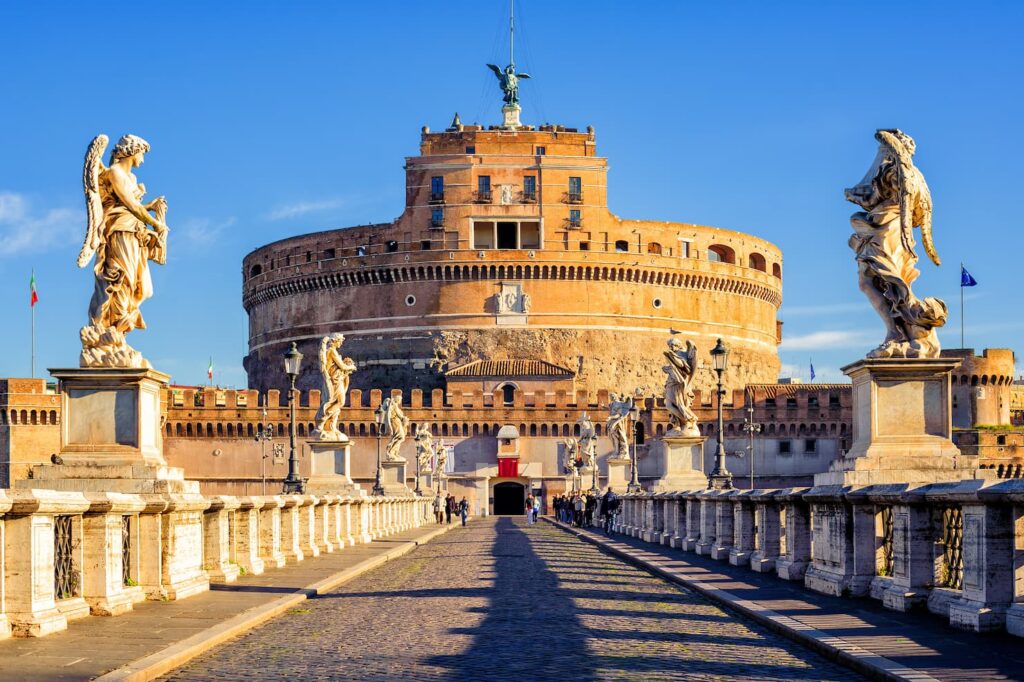
When we think of Castel Sant'Angelo, the image that immediately comes to mind is that of the Sant'Angelo Bridge, the spectacular link over the Tiber adorned with ten statues of angels sculpted by the students of Gian Lorenzo Bernini.
Yet, not everyone knows that this bridge once had a very different, and decidedly more macabre, appearance.
Until the seventeenth century, in fact, there were no statues on the balustrades of the bridge, but the severed heads of those sentenced to death.
Displayed in plain sight, they served as a warning to anyone crossing the Tiber: a warning not to challenge the power of the Papal States.
Only later did the bridge change its face due to the artistic intervention desired by the popes. First the statues of St. Peter's e St. Paul's, then, in the 17th century, came the series of the ten angels that still fascinate thousands of visitors.
Each of the angels brings with them a symbol of the Passion of Christ: the cross, the nails, the crown of thorns.
Castel Sant'Angelo between art, music and pop culture
The allure of Castel Sant'Angelo does not stop with its history and legends: this monument has inspired Musicians, writers, filmmakers and even video game developers.
One of the most famous examples is the work "Tosca" by Giacomo Puccini.
In Act III, right on the castle terrace, Tosca throws herself into the void after the shooting of her beloved Cavaradossi. A dramatic scene that helped fix Castel Sant'Angelo in the collective imagination.
Cinema could not remain indifferent: in the film "Angels and Demons" based on Dan Brown's bestseller, the castle plays a starring role, including secret corridors, underground passages and mysterious symbols.
The world of video games has also paid tribute to this place: in Assassin's Creed II and especially in Assassin's Creed: Brotherhood, Castel Sant'Angelo is one of the most iconic settings to explore.
Finally, modern pop culture has even brought him back in music lyrics. The Roman trapper Achille Lauro, for example, often mentions the Castle in his songs, turning it into an urban and contemporary symbol.
From Puccini to Hollywood, from video games to Roman rap, Castel Sant'Angelo continues to live on and inspire new generations, proving to be not only a monument of the past, but also a timeless icon.
The papal apartments and the room of Cupid and Psyche

Castel Sant'Angelo was not only a fortress and a prison: during the Renaissance it was also transformed into a papal residence of extraordinary splendor.
Among the most fascinating environments are the apartments of Pope Paul III Farnese, decorated with spectacular frescoes that combine mythological themes and Christian symbolism.
The most famous is the room of Cupid and Psyche, inspired by Apuleius' tale.
Here, through allegorical images, The story of the maiden Psyche becomes a metaphor for the human soul Who faces trials and sufferings to achieve eternal salvation.
These decorations, made by some of the greatest artists of the time, testify to how Castel Sant'Angelo was, at the same time, a place of power, refuge and artistic beauty.
Legends and ghosts of Castel Sant'Angelo

Behind the imposing walls of Castel Sant'Angelo are not only historical facts, but also mysterious and ghostly tales handed down from Roman folk tradition.
One of the most famous is that of Beatrice Cenci, the young noblewoman sentenced to death in 1599 for participating in the murder of her abusive father. It is said that her headless ghost still appears on silent September nights, walking restlessly on the Ponte Sant'Angelo.
No less disturbing is the legend associated with Master Titta, the executioner of Rome. Wrapped in his characteristic red cloak, his specter would wander around the castle and bridge at dawn, offering a grab for tobacco, just as it did with the condemned before execution.
These stories, between myth and suggestion, make a visit to the Castle all the more fascinating. For many visitors, walking past its walls at night means Relive the gothic and spooky atmosphere of a place that has seen centuries of suffering, superstition and stories passed down from generation to generation.
The best-selling ever
Castel Sant'Angelo: Entrance ticket + audio guide
Quick access and audioguide included: explore Castel Sant'Angelo and Roman Forum with one ticket.
Secure payment
Immediate confirmation
Cell phone ticket
Frequently asked questions
The best-known ones concern the apparition of Archangel Michael, the various statues that have stood atop the castle, the Passetto di Borgo, and the legends of ghosts.
Yes, the most famous is the Passetto di Borgo, a corridor about 800 meters long connecting the Vatican to the Castle, used by the popes as an escape route.
He was the official executioner of the Papal States, serving for 68 years. He executed over 500 people and his name has remained in popular Roman memory.
Yes, some of the ancient cells can still be visited today, including those that housed figures such as Benvenuto Cellini and Beatrice Cenci.
Absolutely. It is the site of the dramatic ending of the Tosca by Puccini, appears in the film Angels and Demons and even in the video games of the saga Assassin's Creed.
Yes, the best known ones speak of the headless ghost of Beatrice Cenci and that of Mastro Titta with his red cloak.
Conclusions
Castel Sant'Angelo is not only one of the most impressive and visited monuments in Rome, but also a a place of memories, legends and curiosities spanning nearly 2,000 years of history.
From the miraculous appearances of Archangel Michael to spectacular escapes, from dark dungeons to severed heads on the bridge, to quotations in operas, movies and video games: every stone in the castle tells of an episode that unites history, myth and collective imagination.
Visiting Castel Sant'Angelo means not only admiring breathtaking views of the eternal city, but also Immerse yourself in a journey of charm, mystery and fascination Who continue to live to this day.
If you are looking for more information, read the article on the history of Castel Sant'Angelo, from its construction to the present day.
The best-selling ever
Castel Sant'Angelo: Entrance ticket + audio guide
Quick access and audioguide included: explore Castel Sant'Angelo and Roman Forum with one ticket.
Secure payment
Immediate confirmation
Cell phone ticket
